 Contour Desk
Scale
The scale belongs to the copy in your hand
A printed ratio looks reassuringly definite. On a map marked 1:25,000, one unit on the intended print represents twenty five thousand of the same units on the ground. A centimetre therefore represents 250 metres. That relationship is useful, but it depends on the copy retaining its intended size. A page enlarged by a photocopier can still display the original ratio in perfectly legible type while the geometry beside it has changed. The label describes the original design; it cannot detect the copier. Before measuring anything, establish whether the page is an original sheet, a reduced print, or a screenshot that has travelled through several applications.
The line that travels with the map
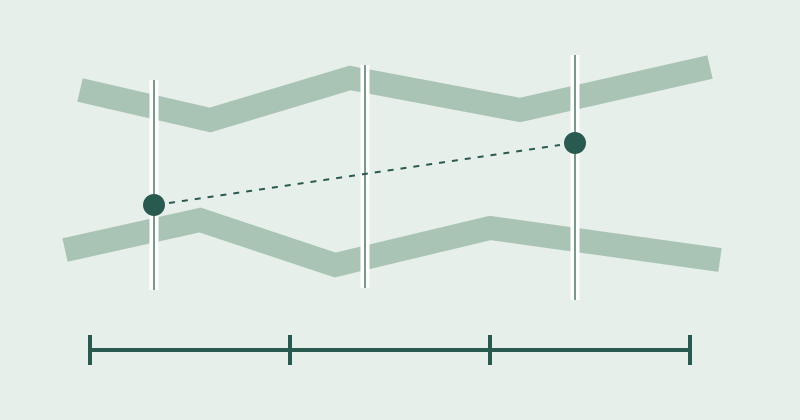
A graphic scale is a different kind of evidence. Its bar is drawn in the same coordinate space as the map. If a complete map and its scale bar are enlarged together, their relationship survives that enlargement. You can compare a distance with the bar without knowing the new print ratio. This advantage disappears when someone pastes a scale bar from another image, crops a map and redraws the bar carelessly, or stretches the image unevenly. Check that the bar actually belongs to the visible map. A handsome legend and a publisher name are not enough to establish that connection.
Consider a simple planning sheet with a bar labelled zero to one kilometre. Lay a strip of plain paper beside the bar and mark its ends. Move that strip to the map rather than trying to perform every comparison with a ruler. If the straight distance between two squares equals three quarters of the marked span, the map suggests about 750 metres. Write that as an approximate map distance. It is not a promise about the walk, the route through an entrance, or the position of a current temporary barrier. The measurement answers one narrow question well when it is not asked to answer several others.
What a smaller copy removes
Reduction also changes legibility. A line representing a minor path may remain present as ink but become difficult to distinguish from a boundary. Small text can merge with contour lines. When a reduced page feels confusing, the difficulty may come from the physical reproduction rather than from your ability to read a map. Enlarging it again can make the printed marks bigger, but cannot restore detail already lost to a poor scan. Look for a better source copy before annotating guesses over an unreadable symbol. Keep the publisher's intended print instructions with a downloaded sheet when those instructions are available.
A ruler measures a straight segment. A route made of bends needs several segments or a flexible trace, and each added turn introduces small choices about where the line runs. For an ordinary town visit, a rounded estimate is generally more honest than a long decimal. If your measurement method is only accurate to a few millimetres, writing 1.437 kilometres gives the number more precision than the page supports. Keep the practical unit in view: whether the distance is roughly half a kilometre or closer to two may matter more than the last twenty metres.
A small note beside the measurement
A useful annotation records three things: which endpoints were used, whether the line was straight or followed a route, and which scale reference supplied the units. For example, write “library door to square, route trace, approximately 0.8 km using printed bar.” Someone returning to the sheet later can then understand the calculation without recreating your assumptions. Avoid writing the result across streets or symbols. Put the note in the margin and connect it with a light reference mark if necessary. A measurement is part of reading the map, rather than a replacement for the features beneath it.
There is no need to turn every map encounter into a surveying exercise. The practical habit is much simpler: look at the reproduction, find the scale evidence, choose an appropriate method, and describe the result at the precision the material can support. If the source has no reliable scale and no trustworthy reference distance, leave the measurement unresolved. A blank estimate is preferable to a confident number borrowed from a ratio that no longer matches the copy.
Keep reading