 Contour Desk
Symbols
Which north does this page mean?
The top edge of a page is an easy substitute for north. It works often enough on familiar maps to become an unspoken rule. Yet a town diagram may rotate the streets to fit a narrow leaflet, and a floor plan may align with the entrance rather than a compass direction. Before relating the page to anything outside it, find the orientation information. A north arrow, grid, or explicit note can tell you how the drawing is arranged. A decorative compass motif in a publication's branding cannot do that job. Look for the mark attached to the actual mapped area.
Three references on one sheet
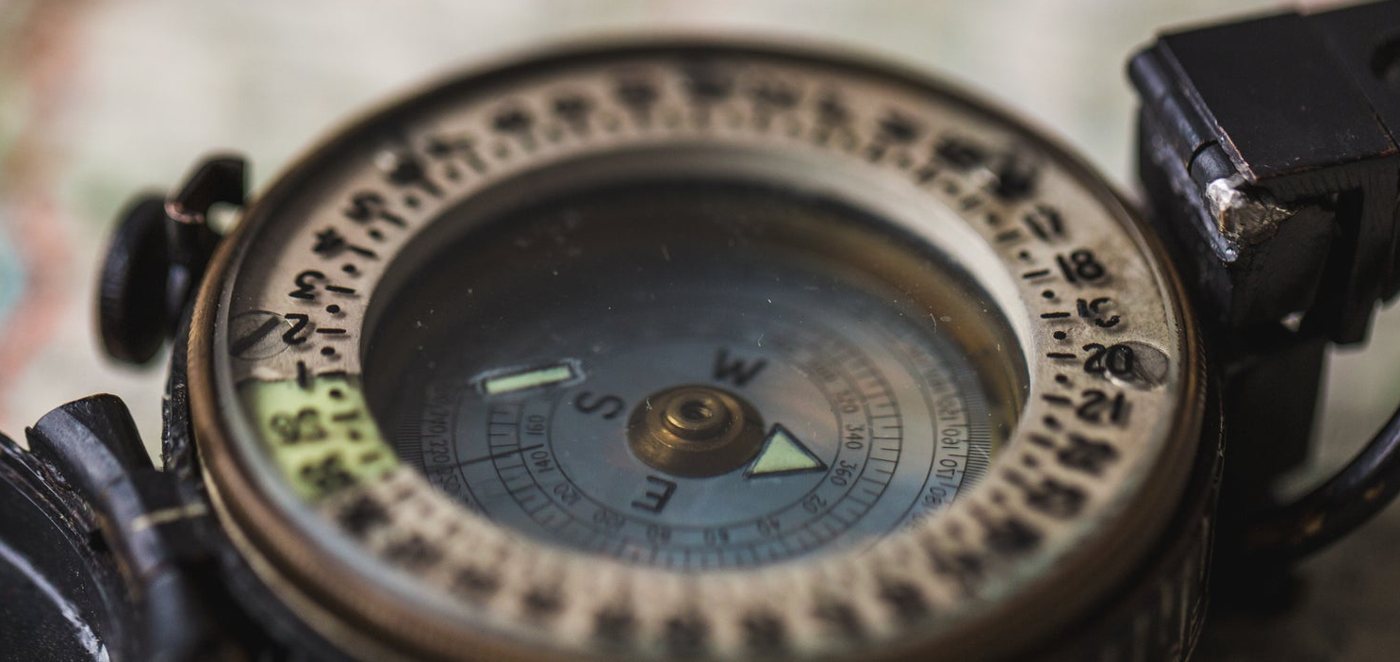
Detailed maps can distinguish true north, grid north, and magnetic north. True north relates to the direction of the geographic pole. Grid north follows the map's rectangular coordinate grid. Magnetic north is the direction indicated by a magnetic compass under the conditions and location of use. These directions need not coincide. A map may include a diagram and dated information about their relationship. Do not collapse all three into the same arrow simply because the differences appear small on the printed page. The labels explain which reference is being used; their practical significance depends on the task.
At a desk, a useful first exercise requires no compass. Find a square grid line and follow it upward. Then find the north indication and read its wording. If the map uses a grid, notice whether the page border is parallel to that grid. On an inset or a cropped reproduction it may not be. Write down the orientation in a plain sentence, such as “The grid runs upward on this sheet, while the inset has its own north arrow.” This is a check of the page, not a field navigation procedure. It helps separate what is drawn from what a reader has assumed.
An inset can turn independently
A harbour inset, station plan, or enlarged town centre may rotate independently of the main map. Its aim can be to make a narrow or diagonal area fit a useful rectangle. Check its own direction mark before transferring a left or right relationship from the surrounding page. If no orientation is given, describe the relationship locally: “beside the station entrance on the inset” is more faithful than inventing an east side. The local wording also helps someone using a different print layout. A page position is not automatically a geographic position.
Magnetic information is especially easy to detach from its date. A photocopy can preserve an old magnetic diagram even when the paper itself looks new. A current-looking cover does not update the base map inside it. For an actual trip that depends on compass use, obtain current, appropriate navigation information and the skills to apply it. This article's purpose is to identify the printed references, not to supply a bearing or an adjustment. Reading a dated note accurately includes recognising that it may no longer describe today's conditions. Keep that uncertainty visible instead of hiding it under a neat calculation.
Describe a page without rotating it in your head
For ordinary reading, try using both map language and page language explicitly. Say “north of the square” when the map supports that statement, and “at the upper left of this diagram” when referring to the layout. The distinction is valuable in written instructions for another reader. Otherwise a person may turn the leaflet and make a correct page-based description seem wrong. When comparing two maps, align their north references before comparing the apparent shapes of streets. A rotated street is still the same street; the page has changed its presentation.
The smallest reliable orientation habit is a pause at the beginning. Identify the mapped area, its own directional reference, and any separate inset. Notice dates where they matter. Once those are clear, the arrow can recede into the background and the rest of the page becomes easier to discuss. Knowing which question a north mark answers is more useful than treating every arrow as a complete navigation lesson or assuming that every straight page edge carries geographic meaning.
Keep reading